.webp)
Air Ambulance Cost in India - Factors That Affect Pricing
Overview of Air Ambulance Costs in India
Air ambulance costs in India can vary significantly based on multiple factors, including the type of aircraft, travel distance, level of medical assistance required, and the urgency of the situation. Domestic patient transfers generally range from moderate to premium pricing, as these services include ICU-grade facilities, advanced medical equipment, and experienced paramedic teams onboard.
Aircraft such as helicopters, ICU-equipped jets, and private air ambulances typically involve higher costs due to their enhanced life-support capabilities and ability to cover longer distances efficiently. International medical transfers are usually more expensive, considering extended flight durations, international clearances, cross-border regulations, and coordination with foreign healthcare facilities.
Additionally, emergency requests, late-night operations, and specialized medical requirements can further impact the overall cost. GoAid Air Ambulance ensures transparent and government-approved pricing while maintaining high standards of patient care, making medical transportation safe, reliable, and cost-effective.
Factors Influencing Pricing of an Air Ambulance Service
Several factors determine air ambulance pricing in India. Understanding these can help families plan budgets and select appropriate services.
- Type of Aircraft
Costs vary depending on whether a normal air ambulance, ICU-equipped jet, helicopter, or private jet is used. Advanced aircraft with ICU support or long-range capabilities increase pricing significantly.
- Distance of Transfer
Longer flights, whether domestic or international, require more fuel, staff time, and coordination, which directly impacts the total cost of the transfer.
- Medical Equipment Required
Patients needing ventilators, monitors, infusion pumps, or cardiac support require advanced medical setups, adding to overall air ambulance charges.
- Paramedics and Medical Staff
Highly trained ICU doctors, nurses, and paramedics onboard increase the cost due to professional expertise and continuous in-flight patient care.
- Emergency Transfers
Urgent or last-minute bookings may incur higher charges because aircraft and staff need rapid deployment without standard scheduling.
- Distance to Airport and Ground Transport
Ground ambulance transfers from hospital or home to the aircraft, especially over long distances or difficult terrain, contribute to the total cost.
- Time of Flight
Night flights, weekends, or holiday transfers may attract additional charges due to operational complexities and staffing requirements.
- International Transfers
Cross-border transfers include additional fees for permissions, documentation, and coordination with foreign hospitals, significantly increasing the cost compared to domestic flights.
- Additional Medical Support
Specialized care such as neonatal ICU, surgical support, or organ transport requires extra equipment and medical staff, affecting pricing.
- Government-Approved vs Private Rates
Government-approved rates are regulated and generally affordable, while private rates vary based on provider reputation, aircraft type, and additional services offered.
Also Read : Top 10 Air Ambulance Service Providers in Delhi
Type of Air Ambulance Available in India
India offers different types of air ambulances to meet diverse patient needs, urgency levels, and distances. This ensures safe, professional, and timely medical transfers for both domestic and international cases.
1. Normal Air Ambulance
Normal air ambulances are suitable for stable patients who do not require intensive monitoring. These aircraft provide basic medical equipment such as oxygen and first aid. This makes them an affordable option for routine transfers.
2. ICU Air Ambulance
ICU air ambulances are equipped with ventilators, cardiac monitors, infusion pumps, and oxygen therapy. A trained ICU team accompanies the patient to provide continuous critical care during inter-hospital or long-distance transfers.
3. Helicopter Air Ambulance
Helicopter ambulances offer rapid response, especially in remote or inaccessible areas. They provide essential medical support onboard, including oxygen therapy and monitoring equipment. This ensures patients reach hospitals quickly and safely.
4. Private Jet Air Ambulance
Private jet air ambulances combine comfort, speed, and privacy for long-distance or international transfers. They are fully equipped with ICU facilities and trained medical staff to manage complex patient care in-flight.
5. Commercial Airline Stretcher Service
Some air ambulances operate via commercial flights with stretcher arrangements for non-critical patients. These services allow secure transfers while providing basic monitoring and medical support throughout the journey.
Also Read : Why Trust Matters in Air Ambulance Services
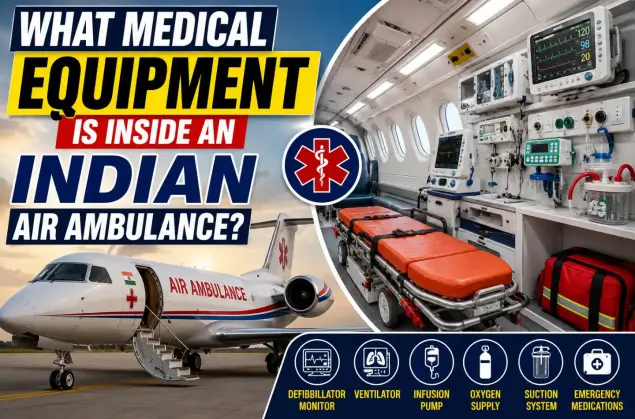
Medical Equipment and Paramedics Available in an Air Ambulance (Usual)
Air ambulances carry standard equipment and trained staff to manage routine patient transfers safely. This ensures stable patients receive continuous care during the journey.
- Oxygen Cylinder
Provides supplemental oxygen to patients experiencing breathing difficulties or low oxygen levels, maintaining proper oxygenation and ensuring patient stability throughout the flight.
- Basic Monitors
Used to track vital signs such as heart rate, blood pressure, and oxygen saturation continuously, allowing medical staff to detect changes in patient condition.
- First Aid Kit
Contains essential items like bandages, antiseptics, and emergency medications to handle minor injuries or sudden health issues during transit.
- Stretcher
Secures the patient safely during transport. This offers comfort and stability while transferring between ground and air ambulance or during the flight.
- IV Fluids
Used for hydration and administering medications intravenously. This ensures patients maintain fluid balance and receive necessary treatments in-flight.
- Basic Airway Management Tools
Includes oxygen masks and nasal cannulas to support breathing and maintain an open airway for patients with respiratory needs.
- Defibrillator (Basic)
A device to manage sudden cardiac events. This provides electric shocks to restore normal heart rhythm in emergencies during air transport.
- Suction Device
Removes fluids or secretions from the patient’s airway, preventing obstruction and maintaining clear breathing throughout the journey.
- Splints and Immobilization Devices
Stabilize fractures or injuries, prevent further damage, and ensure safe handling during patient transfers in the air ambulance.
- Basic Medications
Includes painkillers, fever reducers, and emergency drugs for managing minor or common medical conditions during the flight.
Also Read : Top 10 Myths and Facts About Air Ambulance Services
Medical Equipment and Paramedics Available in an Air Ambulance (Advanced)
Advanced air ambulances are equipped with ICU-level equipment and highly trained medical staff to manage critically ill or complex patients safely during transfers.
- Ventilator
Supports patients with respiratory failure by providing controlled airflow and oxygen. This ensures safe breathing during critical transfers.
- Advanced Cardiac Monitor
Monitors ECG, heart rate, and blood pressure continuously, allowing real-time detection of cardiac issues and timely medical intervention.
- Infusion Pump
Delivers precise doses of IV fluids and medications, maintaining patient stability and ensuring accurate treatment during long-distance transfers.
- Defibrillator (Advanced)
High-end device for cardiac emergencies, capable of delivering controlled shocks to restore normal heart rhythm in life-threatening situations.
- Oxygen Concentrator
Provides continuous, adjustable oxygen supply for patients with respiratory distress or ICU-level oxygen requirements throughout the flight.
- Portable Suction Machine
Efficiently removes secretions from the airway, preventing obstruction and maintaining clear breathing for critically ill patients during transit.
- Nebulizer
Delivers inhaled medications to patients with respiratory conditions like asthma or COPD. This ensures controlled medication administration during flights.
- Infusion & Medication Supplies
Contains essential emergency drugs, analgesics, and life-saving medications, administered by trained staff for continuous care in-flight.
- Advanced Airway Management Kit
Includes intubation tools and adjunct devices for securing and managing the airway of critically ill patients.
- Trained ICU Paramedics and Doctors
A professional medical team provides continuous monitoring, emergency interventions, and critical care. This ensures patient safety and comfort throughout the journey.
Also Read : Air Ambulance vs Commercial Flights
Domestic vs International Transfers – How Does Cost Differ?
Domestic air ambulance transfers are generally shorter, covering inter-city or inter-state distances within India. Costs are influenced by aircraft type, distance, medical equipment, and staff required. Normal air ambulances or ICU-equipped jets are commonly used for domestic transfers, balancing affordability and patient care.
International transfers involve longer distances, cross-border regulations, and coordination with overseas hospitals. The cost is higher due to international flight charges, permissions, customs clearance, and logistical support. ICU or specialized medical support during the flight adds to the total expense.
Emergency situations, night transfers, or last-minute bookings can affect both domestic and international costs. Helicopters or private jets used for rapid transfers increase pricing further. Families need to plan for additional ground ambulance charges and airport coordination in both cases.
Despite differences, both domestic and international transfers maintain high medical standards. GoAid ensures ICU facilities, trained paramedics, continuous monitoring, and communication with receiving hospitals. Families can rely on professional, safe, and timely transfers, whether within India or across countries, without compromising on patient care.
Cost of Additional Services: Emergency & Specialized Care
Air ambulance charges can increase with emergency or specialized care requirements. Emergency transfers demand rapid deployment of aircraft and staff, often outside regular schedules.
Specialized care includes ICU support, ventilator management, neonatal or pediatric ICU, post-surgery transfers, and organ transport. Additional equipment, extra medical personnel, and advanced monitoring systems increase costs.
Night flights or weekend transfers may also attract surcharges. GoAid ensures transparent pricing for these services, helping families plan effectively.
Despite additional costs, specialized support guarantees patient safety, continuous monitoring, and professional in-flight care. This makes emergency and critical transfers reliable and stress-free.
Which One to Choose: Government-Approved vs Private Rates?
Government-approved air ambulance rates are regulated, transparent, and generally more affordable. They ensure standardized pricing for domestic and international transfers. This makes them suitable for budget-conscious families without compromising safety.
Private air ambulance rates vary depending on aircraft type, distance, ICU support, and additional services. While sometimes higher, private providers may offer faster response, customized care, and flexible transfer options.
Families should evaluate patient condition, urgency, and available facilities before choosing. GoAid provides both cost-effective government-approved services and premium options for advanced care.
This ensures families receive high-quality, safe, and timely transfers while selecting a plan that fits their medical and financial needs.
Also Read : Air Ambulances Help Critical Patients Reach Hospitals Faster
Tips to Reduce Air Ambulance Costs
Air ambulance transfers can be expensive, but following practical tips helps reduce costs without compromising patient safety, care, or service quality.
- Plan in Advance
Scheduling transfers early allows better aircraft allocation and reduces emergency surcharges. Pre-planned transfers minimize last-minute charges and ensure efficient coordination with medical staff and hospitals.
- Choose Appropriate Aircraft Type
Selecting the right air ambulance type based on patient condition - normal, ICU, or helicopter - prevents unnecessary costs associated with over-equipped aircraft.
- Use Government-Approved Rates
Opting for government-approved pricing ensures standardized and transparent charges. This makes transfers more affordable while maintaining quality medical care.
- Avoid Emergency Bookings When Possible
Non-critical cases can be scheduled in advance. Emergency or last-minute bookings often attract higher fees due to rapid deployment requirements.
- Consider Ground Ambulance Options for Short Distances
For nearby hospitals, using a ground ambulance instead of an air ambulance reduces expenses while still ensuring safe transport.
- Opt for Shared Services for Non-Critical Patients
Some providers allow cost-sharing or stretcher services on commercial flights. This reduces individual transfer expenses for stable patients.
- Verify Insurance Coverage
Confirm whether health insurance covers air ambulance services. Insurance can significantly reduce out-of-pocket expenses for both domestic and international transfers.
- Select Efficient Routes
Choosing the shortest or fastest flight route minimizes fuel usage, flight time, and operational costs. This reduces total transfer charges.
- Avoid Non-Essential Additional Services
Skip extra features like luxury jets or unnecessary onboard equipment for patients who do not require critical care.
- Book Directly with Trusted Providers
Direct booking with reputable providers like GoAid avoids intermediaries, hidden charges, and ensures cost-effective, transparent pricing.
Also Read : Cabin pressure in air ambulance care
The Most Affordable Air Ambulance Service Provider in India
GoAid is recognized as one of India’s most affordable and reliable air ambulance service providers. With a nationwide presence, it offers both domestic and international patient transfers. This ensures safe and timely medical care.
GoAid maintains government-approved rates while providing advanced ICU-equipped aircraft, trained paramedics, and doctors onboard.
Their diverse fleet includes normal, ICU, helicopter, and private jet air ambulances, catering to patients with varying medical needs. By combining cost-effective pricing with high-quality service, GoAid ensures families receive professional, stress-free, and safe patient transfers without compromising on care.
Transparent pricing, multiple booking options, and nationwide coverage make GoAid the preferred choice for affordable air ambulance services in India.
How GoAid Offers Affordable Air Ambulance Services?
GoAid ensures affordability through government-approved charges and transparent pricing for domestic and international transfers. Pre-assessment of patient needs allows selection of the most suitable aircraft, avoiding unnecessary costs.
Multiple booking options via app or helpline reduce administrative overhead, while optimized flight routes minimize fuel and operational expenses. Standardized ICU equipment and medical staff deployment ensure safety without inflating costs.
GoAid also offers cost-effective packages for emergency and specialized transfers, including pregnancy, neonatal, or organ transport services. With nationwide coverage and experience in handling diverse medical cases, GoAid provides professional, reliable, and budget-friendly air ambulance solutions.
This makes high-quality medical transfers accessible to patients across India.
Conclusion
In conclusion, we have provided the details about Air Ambulance Cost in India: Factors That Affect Pricing. GoAid ensures safe, reliable, and affordable air ambulance transfers.
This offers government-approved rates, advanced medical support, ICU facilities, and trained paramedics. Families can access both domestic and international services, emergency or scheduled transfers, with transparent pricing and multiple booking options.
By understanding factors affecting costs and choosing trusted providers like GoAid, patients receive timely, professional care without unnecessary financial burden.
FAQs
Q1: What factors affect air ambulance costs in India?
A: Costs depend on aircraft type, distance, ICU support, medical staff, emergency requirements, additional equipment, night flights, international transfers, and ground ambulance services.
Q2: How can I reduce air ambulance costs?
A: Plan in advance, choose appropriate aircraft, use government-approved rates, verify insurance, avoid last-minute bookings, select efficient routes, and book directly with trusted providers like GoAid.
Q3: Does GoAid provide international air ambulance services?
A: Yes, GoAid offers international transfers with ICU support, trained paramedics, full equipment, cross-border coordination, and communication with receiving hospitals for safe patient transport.
Q4: Are GoAid air ambulance services available 24/7?
A: Yes, GoAid operates round the clock, 365 days a year. This ensures immediate response and professional care for both domestic and international patient transfers.
Q5: What types of air ambulances does GoAid offer?
A: GoAid provides normal air ambulances, ICU jets, helicopters, and private jets, all equipped with necessary medical equipment and trained staff for safe patient transfers.